STEPBRIDGE
ADAPTED EDUCATIONAL LEARNING CENTER
ADAPTED SCHOOL CURRICULUM
We provide group classes and individual work according to each child’s abilities, needs, and difficulties.
We follow both Khmer and English programs.
SOCIAL SKILLS AND BEHAVIOR
We provide activities to strengthen children’s listening, understanding, and ability to follow instructions. We help them express their needs and feelings, manage their anger, and follow safety rules.
GUIDANCE, ADVICE TO PARENTS
We guide parents and provide advice, recommendations, and practical exercises to help them cope with any difficulties they encounter with their child. We use a weekly communication notebook.
A school for special needs children
Listening allows us to connect with the world around us, communicate, and socialize. Special needs children may listen less, not really interact with their environment or with other people, and may not follow instructions.
We help children raise their level of awareness and improve their listening skills so that they can listen to their parents at home, listen and follow instructions at school, pay more attention to and understand their surroundings, and concentrate on a task or exercise throughout an activity.
A child who listens well and learns to follow instructions can also better control their emotions and tolerate frustration.
Many parents ask their children to “learn, learn” and acquire more knowledge. We are, however, interested in the link between knowledge and its practical application through concrete actions.
Some special needs children are able to read, spell words, and write sentences, but do not really understand the meaning of what they read or write. These same children are sometimes unable to follow simple daily-life instructions such as “Please go and get a glass of water,” “Please take your bag,” “Do you want to play with me?” or “Which song do you like?”
Indeed, it is essential that a child listens to and understands their interlocutors, makes themselves understood, can formulate a request according to a real need or desire, responds or reacts appropriately, and adopts the most appropriate behavior according to the context.
We therefore focus all our work on UNDERSTANDING: understanding the world around us; the relationships between things and their environment; relationships between people; and the concepts essential to everyday life and learning—language, reading and writing, mathematics, science, and social skills.
Whether a child better understands spoken language or needs visual or auditory aids, it is important to establish, with the parents and the child, clear ways to understand each other and communicate, and achieve greater social integration.
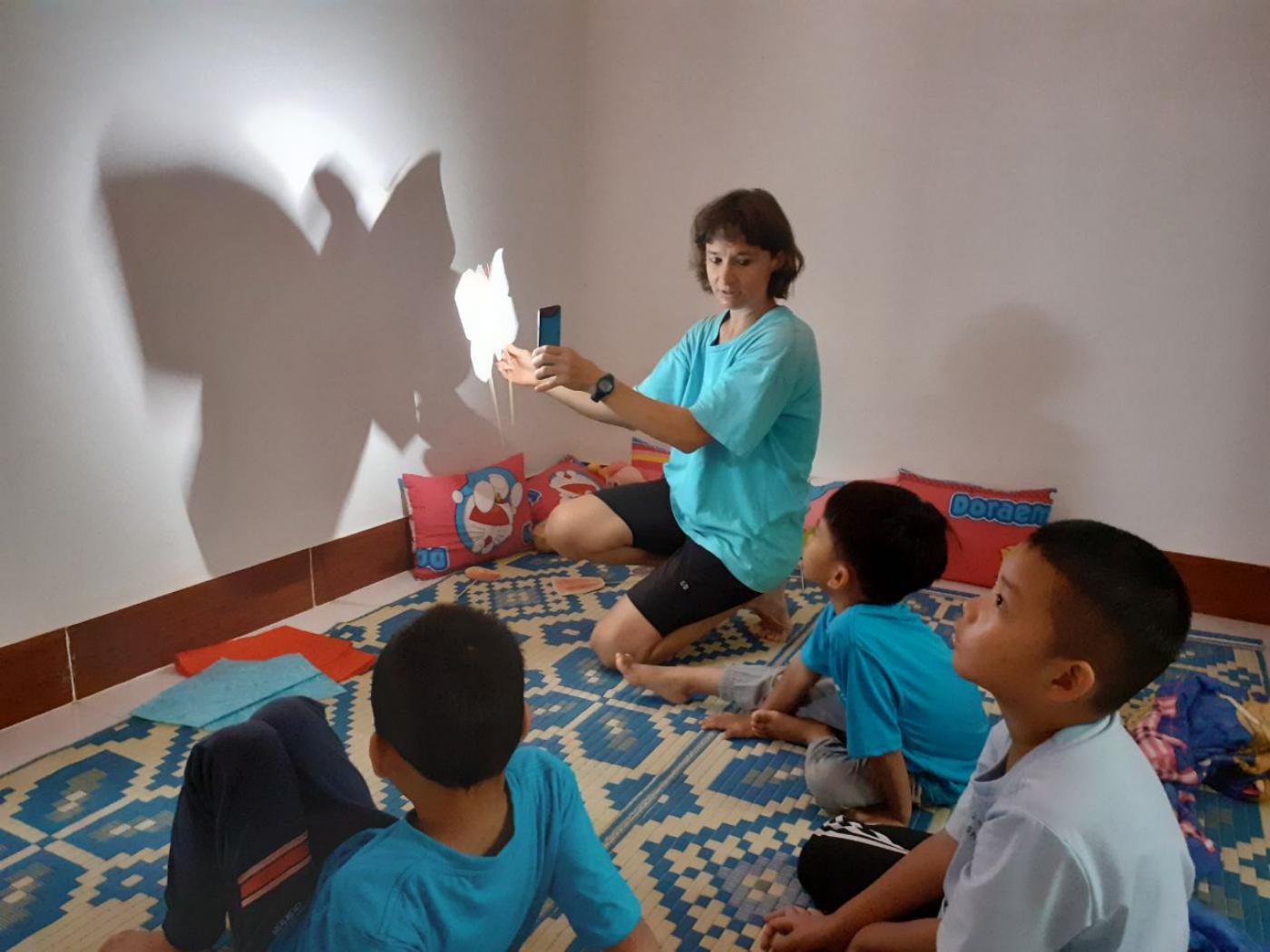
We prepare shared activities in small groups, and a lot of individual work is dedicated to each child, according to their abilities, needs, and difficulties. We follow the English and Khmer school curricula, at each child’s own pace.
Whatever the learning disorder or disability, we gently try to expand the range of activities and possibilities, as well as interests and games. Each concept is taught through various activities, materials, and hands-on experiences.
Many parents encourage their children to learn, but it is also very important to establish and work on positive learning dispositions and aptitudes. Being engaged in relationships, motivated to learn new things, active, focused, persevering, and creative is essential for the smooth running of education and learning. These dispositions and aptitudes have an impact on learning capacity and on the quality of progress in knowledge and skills.
Stepbridge first establishes a learning environment in which the child feels valued, safe, confident, and respected; is guided by clear rules of conduct; and is supported in their efforts, interested, and motivated.
Who has not known parents struggling to make themselves heard and to be obeyed by their little ones? How can parents make a child listen to them, follow instructions, and adopt appropriate behavior?
Some children get angry easily and have more tantrums than others—they scream, hit other people or hurt themselves, throw objects, and may become violent. From around 18 months of age, this can be part of a child’s normal development. Children test their parents and their limits, seek attention, and often have a lower tolerance for frustration. However, this behavior is more common among special needs children who have difficulty expressing themselves or their feelings, experience speech delays, or suffer from anxiety. It therefore remains important to help them face constraints, set clear limits, and use simple words to describe what is happening.
We therefore establish clear rules and their consequences through meaningful actions, and we help parents do the same at home, according to the child’s age and level of maturity.
We prepare activities, exercises, and games designed to improve their behavior, and help them acquire good work habits both at school and at home.
We also help special needs children develop eye contact, work on attention, and improve eye–hand coordination in order to prepare them for school inclusion. We further support them in expressing their feelings, needs, and pain, so that they can grow and gradually learn to express and manage anger without violence, screaming, or throwing objects, and to follow safety rules.
Good hygiene habits are best established early. Having good hygiene not only keeps children clean and healthy, but the benefits can also extend to other areas of their lives. Children with good hygiene habits tend to have higher self-esteem and learn the importance of self-care.
As a parent, it is important to set a good example of basic hygiene for your children. Take care of yourself and reinforce these hygiene skills with them. Do activities together and explain how each task should be done.
Hand Washing
At the Stepbridge we make sure children use soap and lather well. Hands are washed before and after lunch, after using the toilet, after playing outside, and after school.
Good Eating Habits
We encourage good eating habits, such as sitting properly while eating and throwing garbage into the bin.
Covering Coughs and Sneezes
This is not only a basic hygiene skill for children, but also a lifelong habit. Covering a cough is a sign of respect for others. Sneezing into a tissue and washing hands afterward is the most hygienic practice.
Toilet Skills
At Stepbridge, we encourage your child to use the potty or toilet in the morning and before or after snacks and meals. We also remind children to use the toilet when transitioning between activities.
We welcome parents and their child before the start of schooling and before establishing an Individualized Educational Project/Program (IEP).
Each program is developed in collaboration with the child and their family. An IEP is based on observations of the child’s needs, resources, skills, and difficulties, as well as on parents’ requests. It sets clear, precise, coherent, appropriate, and achievable objectives, along with the means and strategies to reach them. It is defined for a specific period—3 to 6 months or 6 to 12 months—is evaluated regularly, and updated according to the child’s progress. It may cover one or more areas, such as learning, communication and language skills, behavior, social skills, fine motor skills, and others.
We provide advice, recommendations, and practical exercises to parents to help them cope with any difficulties encountered with their child. We share a communication notebook, we assign more engaging home activities or suggest tasks and exercises to be done at home with the child, in order to encourage them and ensure consistent follow-up at home.
PROGRAMS & FACILITIES
We welcome children aged 3 to 12 years old.
There are 5 children per class.
We work on speech delay, social and communication skills, behavioral issues, learning disabilities.
We follow and adapt Khmer and English school curricula, develop language, reading and writing / spelling skills, math and logic, reasoning skills, science, arts, gross motor skills, sport and fine motor skills.
We help children to grow by combining special education with general education´s methods and tools.
We prepare small groups´activities and individual programs according to the educational needs, resources, difficulties of each child. We prepare them as much as possible for inclusive education.
We give homework, advice and recommendations to the parents to ensure educational follow-up at home.
We provide all required materials, snack and beverage – water and juice milk -. Children can bring their own lunch box or snack and their bottle of water.
An observation, development and skills´assessment report is written every 6 or 12 months.
REGISTRATION, PRICE
REGISTRATION
The annual registration fee is 20 USD including:
- Materials & homework
- Office & administrative costs
- Snacks & beverage
- Folder & notebook
- School T-shirt
MONTHLY PRICE
Tariff set according to frequency as follows:
- Part-time USD 165 to 175/month
- Full-time USD 210/month
Payment is due at the beginning of each month.
ABA & ACLEDA are accepted.
OPENING HOURS
- MONDAY to FRIDAY
7:30AM to 11:15AM
1:30PM to 5:00PM
SCHOOL CALENDAR

TERMS & CONDITIONS
Sandra, founder, special educator & teacher
Committed, with a strong professional conscience.
Founder and coordinator of Stepbridge, Sandra is a special educator and teacher. She has gradually specialized in early childhood and disability education.
“I worked in day care centers, youth centers, and schools, supporting young children with learning disabilities. I also taught in nursery and kindergarten classes, as well as in the special education department of the institute from which I graduated. I also hold a degree in law and criminology. Above all, I enjoy applying my dynamism and creativity to the education and teaching of young children who require multidisciplinary, alternative educational approaches and methods.”